Cheap Trick

Rockford, Illinois: In Davis Park at Founder’s Landing on the Rock River, there is a three sided historical plaque. One side commemorates the German immigrant who first set up camp here and built a thriving business that he lost in the Panic of 1847, before drifting back east. The second side, I’m afraid is lost to my poor reporting skills, and the third, a little worse for wear, to hometown hero’s “Cheap Trick.”
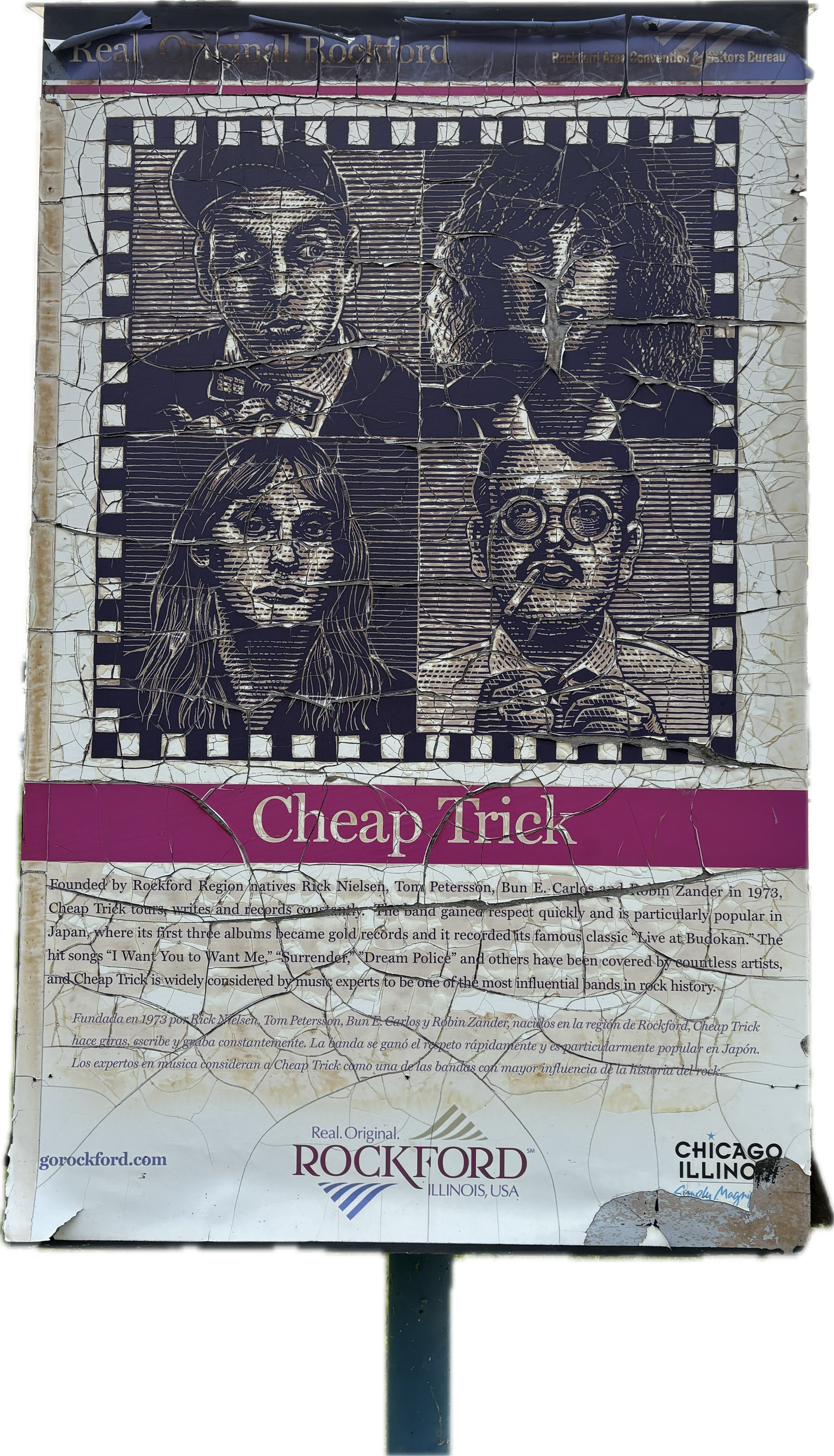
The band, formed in Rockford in 1970, pop with enough of a touch of punk to excite the mid-west, has a lyric memorialized on a local building, “I want you to want me.” Or, for those familiar with their live performances, “I want you to want MEEE.”
It may be the current theme of the Democratic Party. They want, need, beg, to be loved. They are sure you are tired of…..well, you know.
I’m back reporting, with colleague Jack, from the road, this time from Rockford, Illinois to Minneapolis, Minnesota, via Iowa, after a break to write a book based on the observations recorded here on the blog, due out in April, 2026, by Turner Publishing. It can be pre-ordered here: “How the Democrats Lost Steve: Making Sense of the 2024 Election.” Trips from here out will be to take the pulse of the voting public in Trump 2.0.
We return to the Machine Shed in Rockford, a family owned chain of restaurants “dedicated to the American farmer” I buy a Shed coffee mug to add to the eclectic mix in our Maine camp from the manager overseeing the impressive gift shop, after finishing off a breakfast that will hold me well through lunchtime.
He’s retiring after 30 years, having started in their Des Moines location, and then Davenport, which is my next stop. He has a new grandchild and he’s looking forward to not working seventy hours a week. He was called in the other day for sixteen hours to cover absent staff and he’s old enough to be done with that.
The Machine Shed is the type of place people stay a long time, lingering and chatting over brunch in family sized groups, or for years, if you work there. A restaurant job you can make into a career, one that could support a family and give you enough to retire on is, we lament, a dying thing. Maybe promoting policies to encourage more businesses like that would be endearing for a political party trying to connect. Something to think about.
A logical question might be what such support from might look like that might translate into policy Democrats could promote. I suppose we could ask the manager.
He is looking forward to spending time with a grandchild, his first. His replacement has been hired and to me he seemed a bit wistful. Meeting the person who is taking your place has a certain weight to it. He tells me he might find something to do after he’s done here, not really ready to hang it up entirely.
Two years ago Jack wrote about the Machine Shed and his conversation with Brittney, who still works here, Britta, our server today tells us. (Here is Jack’s reporting on Rockford from May 2024)
Mule. Nag.

By Jack BurdenThanks for reading Scott Ferson’s Newsletter! Subscribe for free to receive new posts and support my work.
Britta and Brittney have worked side by side for a good while.
I ask the manager how things have changed over thirty years, working in a place where food and service remaining the same is a part of their success. He tells me a lot of times people don’t show up for job interviews and even after they’re hired may not show up for work. Things have changed, even in Britta and Brittney’s time, giving their work ethic even more value.
One of the perks of retiring is noting how things aren’t like they used to be. The manager and I are the same age, but I don’t tell him, though not retired, I’m on a quest to explain why things have changed in my work world of politics. People used to love democracy.
Leaving Rockford I head southwest along the Rock River to the Quad cities, but people there will tell you there are five of them. I highly recommend a leisurely drive through the Rock River Hills, lush on both banks of the river, pontoon boats moored at the ready, through the towns of Byron and Oregon, through Lowdon and Castle Rock State Parks and into Dixon, home of a young Dutch Reagan.
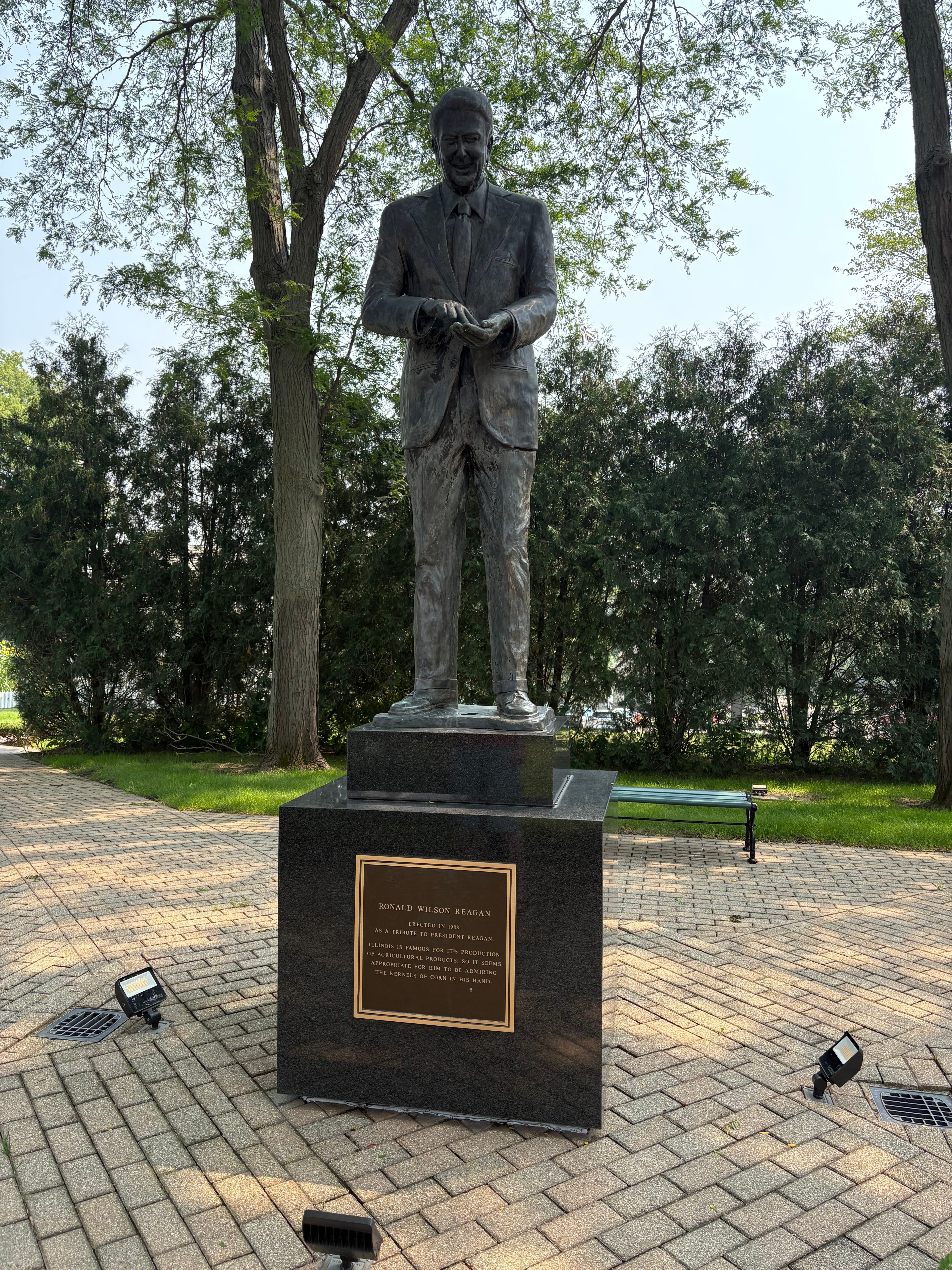

Someone has discovered the typo in the statue’s plaque and sanded down the apostrophe in “its” and, with that, I’m on my way to Iowa.
I asked the Machine Shed manager what I should see in Davenport. “The river!” And there it is, a working one more than a tourist one, of course. Leave your pontoon boat behind, though the only boat traffic is a small one net fishing in the churn generated from the dam.
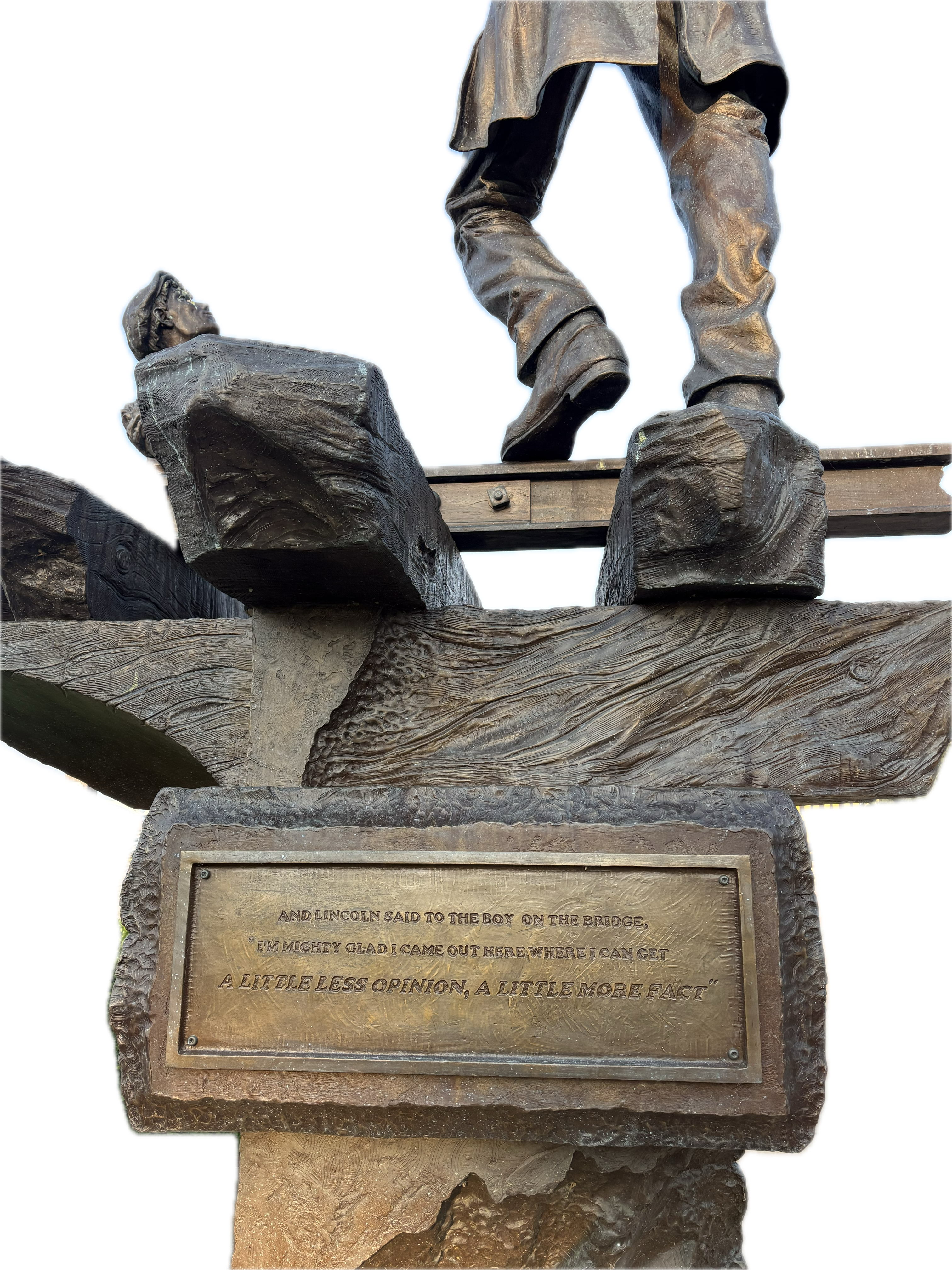
On this Iowa side of the Mississippi there is a statue of Lincoln. “I’m mighty glad I came out here where I can get a little less opinion, a little more fact.”
At Source, the largest used bookstore in Iowa, I buy a 1928 campaign biography of Herbert Hoover. It’s full of optimism for continued prosperity if we
vote to replace silent Cal, who believed what was good for General Motors was good for the country, with someone who made a fortune in business before the boom, and then fed Europe after World War I. Powerful argument. Of course we know what happened.
We live in uncertain times, but so far one in four are not unemployed, like the Great Depression, when Roosevelt said the only thing we had to fear was fear itself. The 1928 promotional presented no dire warnings. Hoover was the obvious choice for those interested in a growing economy. Until he wasn’t.
Today, we’re barraged with dire warnings.
Source’s owner is new. He and his wife bought it from the founder seven months ago, having shopped there for years. I ask him how business is. It’s good but unpredictable. Slow weekend followed by a packed weekday. Then reversed.
I tell him a friend in the book business says stores like his fail because new owners “hug their book”, it’s a passion buy. He says he’ll push stock all day long. He loves them as they should be loved, resold into the world for new readers.
Jack asks about present conditions and buying a business in this age of uncertainty, if it is one. He says “the masses are in ashes.”
A few doors down the owner of Billy and Me Bar and Grill makes the 12:15 round of tables to thank the patrons for their business. I tell him the caesar salad is really garlicky. He’s unsure. I say “in a good way.” He says he likes a robust garlic. As I’m leaving, he’s perched at the end of the bar talking to his manager and I ask why the burger comes with lettuce, tomato, red onion and pickles “upon request to reduce waste.”
The manager perks up and tells me that so many people leave the pickles on the plate that he can calculate the savings by providing it on request. Don’t get him started on how many little paper cups full of ketchup he collects untouched. The owner says he looked into making his own, but it was cost prohibitive. Same with pickles. Somewhere Teresa Heinz breathes a sigh of relief.
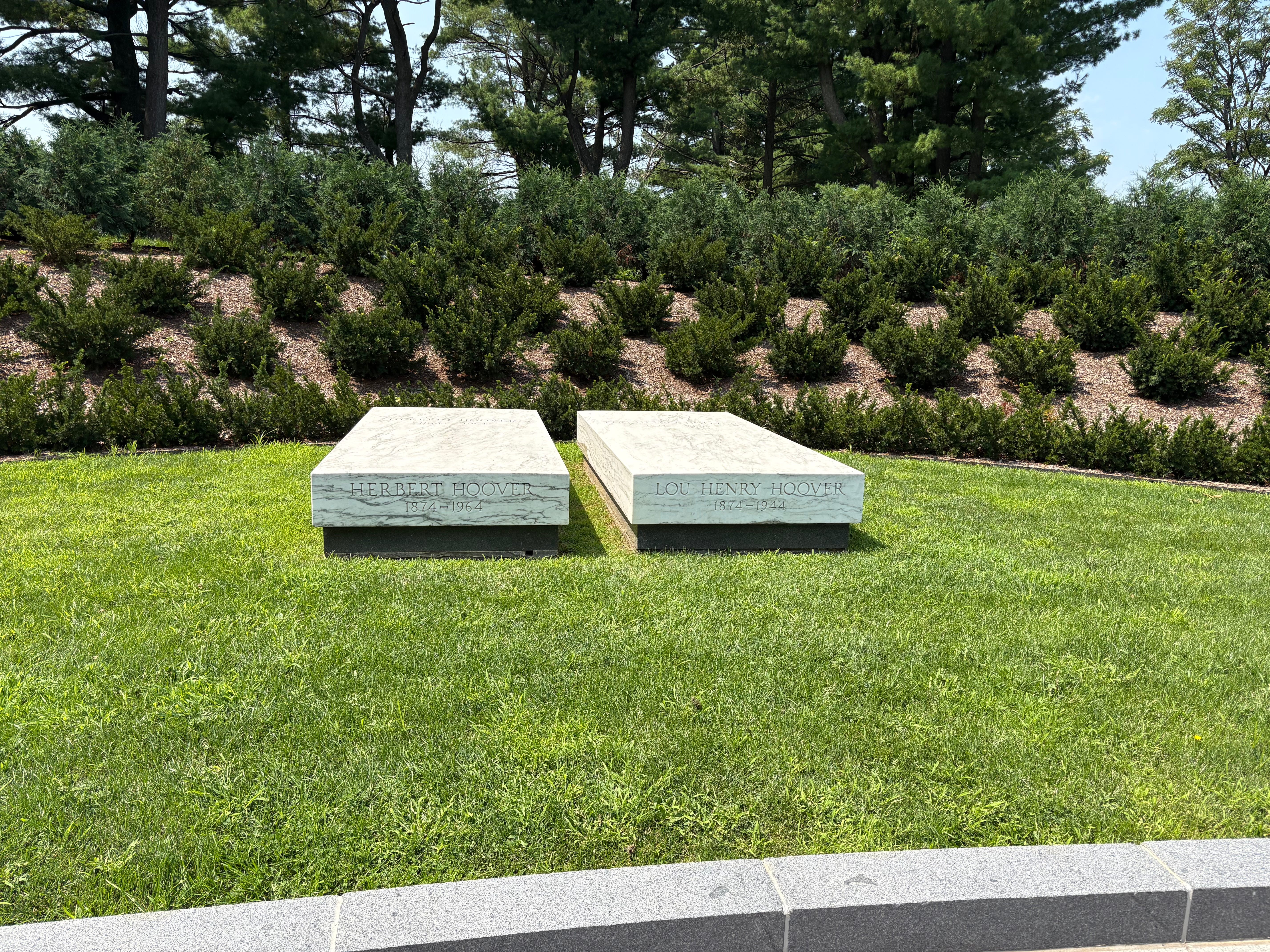
We roll on the hills of Iowa, corn almost as high as an elephant’s eye, between Davenport and Des Moines, interrupted only to pay tribute to the Hoovers, Lou and Herbert, at rest in his hometown of West Branch, the idyllic setting only interrupted by the highway McDonald’s sign peaking above the treeline.
The Hoover Library is closed for renovation but nearby the largest truck stop, I believe in the universe, is open 24/7. I spend some time watching the drivers back in to their parking spots next to the truck wash. This should be an Olympic event.
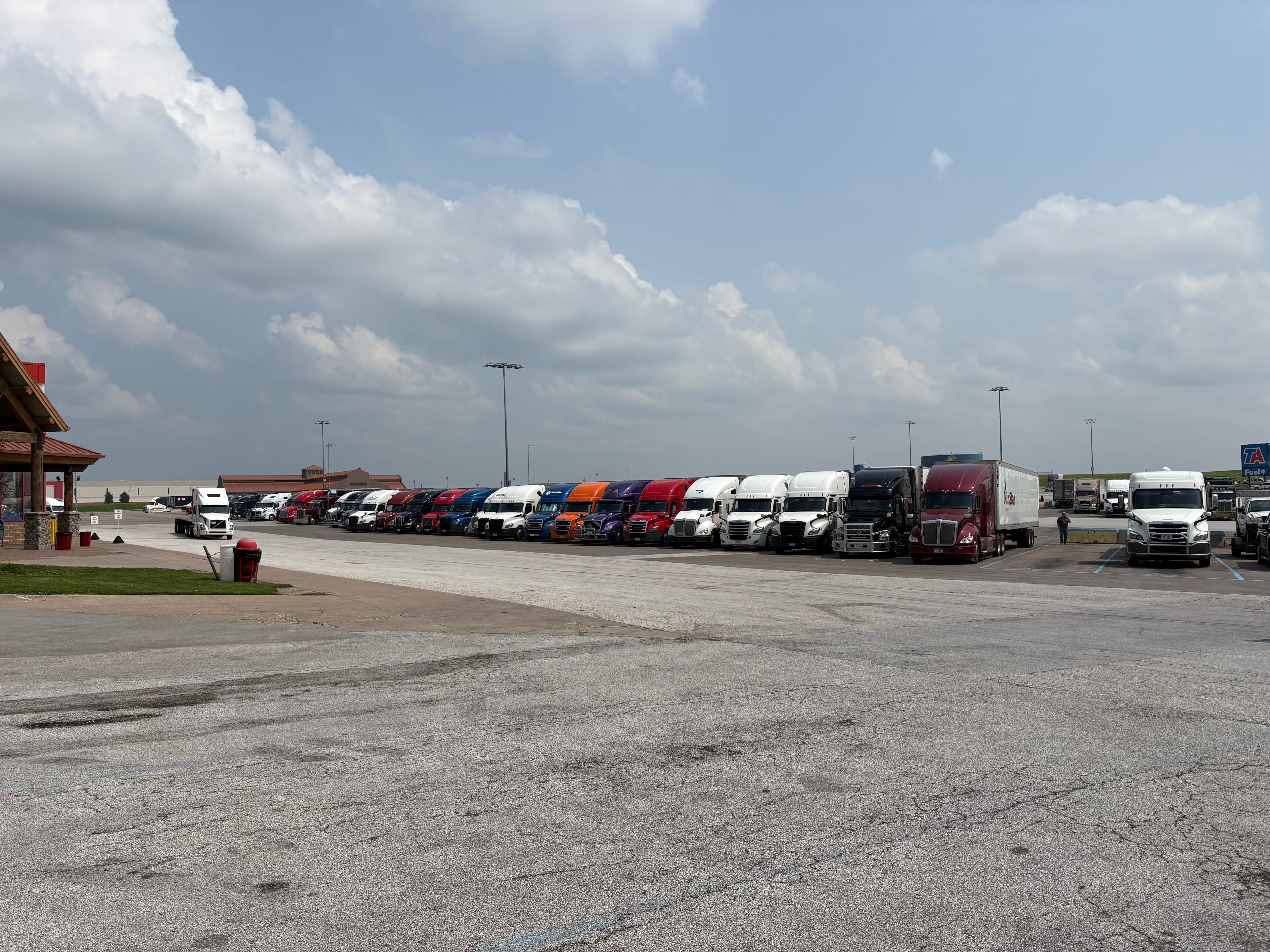
Each truck I’m sure has a story, the goods in the back, whether their payload is impacted by tariff roulette, though it’s hard to imagine that one wouldn’t in some fashion. To find out I would risk my life crossing the lot, so I don’t and continue my quest.
I get a chance the next day in Des Moines to ask about tariffs without risk of life and limb, at the bar at the downtown Marriott in Des Moines. The bartender is girding for the return of dozens of Nascar fans, fresh off a day at the Iowa Speedway, and ignores the gentleman seeking her attention to my left. She’d prefer he return to his table to order, where he was sitting with his family. He’d prefer quicker service at the bar, and she reluctantly complies.
Bob’s from Davenport and I tell him I was just there. He runs a family business that sells church furniture, and he’s telling me he’s easing his son Brandon into the business when his son joins us. He introduces me as his new friend from Boston, “who looks down on us because we’re Iowa farmers.” I look at Brandon and say “that’s not true. We look down on everybody.” They laugh and Brandon shakes his head and says “that’s so true!”
Bob thought tariffs would be a problem, but it hasn’t had much impact. The big ticket items, 30 thousand dollar carved statues from Italy, haven’t been affected. China tariffs more so. I ask what comes from China. “Everything.”
He’s recruiting the next generation in a family business that relies on a shrinking market, church construction. I ask if they supply sound systems, my visit to an evangelical church in Ohio had an impressive one to support their contemporary music service. Bob says no, but Brandon nods to the missed market opportunity. But Bob knows his business, and it’s kept its profitability, since he pays lots of money to “Mr. Google” who helps monetize his niche.
A bit north, in Ames, home to Iowa State, they face an artificial contraction of their bread and butter, federal research dollars, and I’d place a bet that at some point they’ve studied butter, if not bread. Their Republican senators may protect their millions in research dollars, but their funding from the Department of Agriculture has been cut 50%.
We’re realtor Alicia’s first visitors to her listings three bedroom (one in the basement) open house on a cul-de-sac not far from campus. Built in 1992 its been updated in off-whites and carefully staged for showing. In contrast, the family across the street is also marketing theirs for sale, by owner, and their strategy seems to be to crowd the front yard with furniture, cars and kids, presumably to make the interior less cluttered.
Alicia’s staging company has created a surface lifestyle one might wish to have: formal china, plastic desserts under glass, candles and just so throws on the couches, wine and cheese on the table on the patio. It’s so enticing there is a sign on the master bed: “Please do not sit.”
It’s priced at $495,000, which seems high to me, but it is a college town. Alicia says there is uncertainty in the market because of the threats to funding cuts, so it’s a bit of a buyers market. We don’t talk politics beyond that, and Alicia sold real estate in the DC area for years where to do so was prohibited, your political affiliation holding protective status.
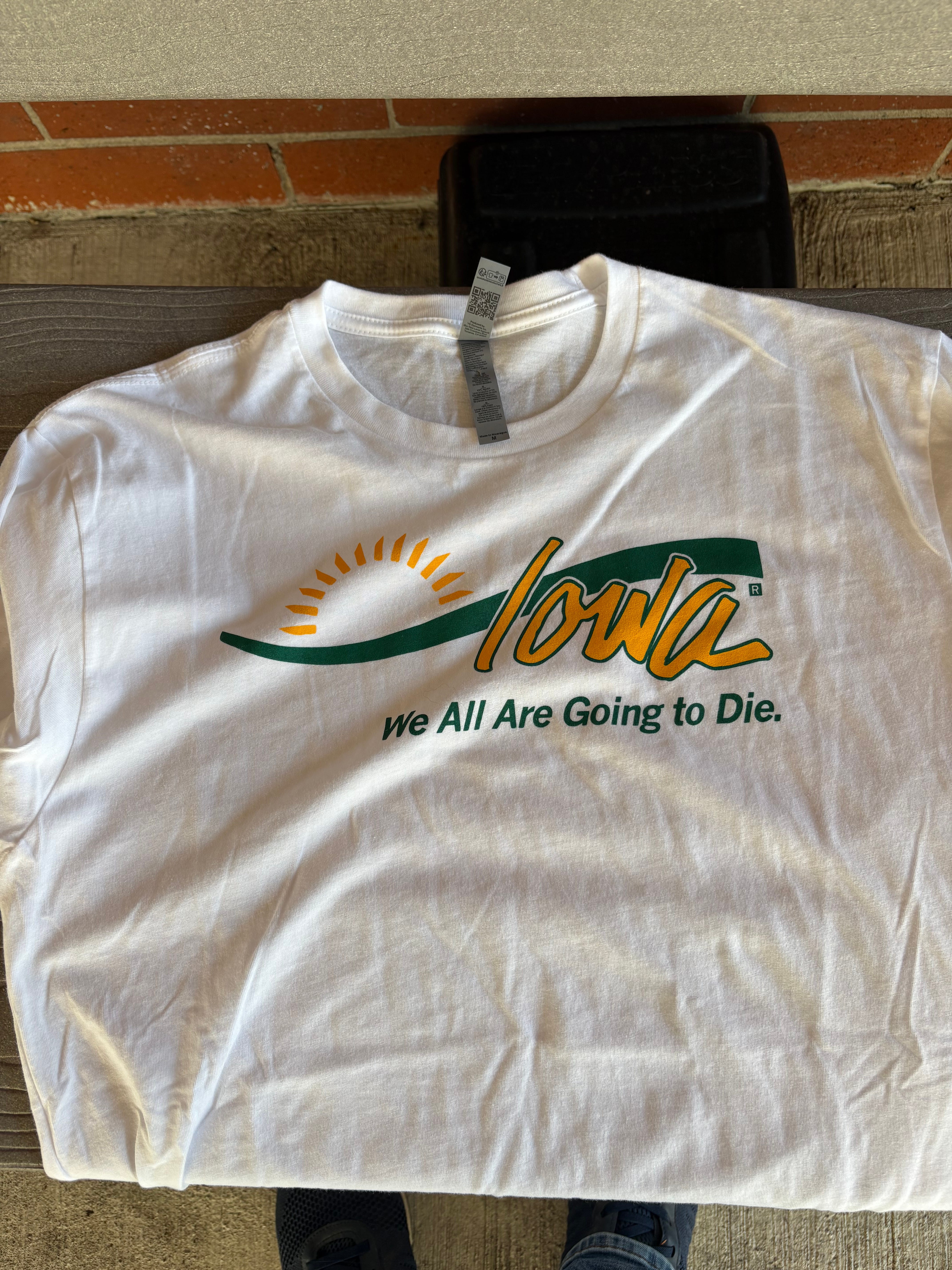
I’m glad I wasn’t wearing my new T-shirt, quoting Iowa Senator Joni Ernst on cuts to Medicaid:
Ames to Minneapolis is a straight shot through rolling hills of corn and soy, the humidity a result of “corn sweat,” or evapotranspiration, the release of pent up water absorbed while plants grow.
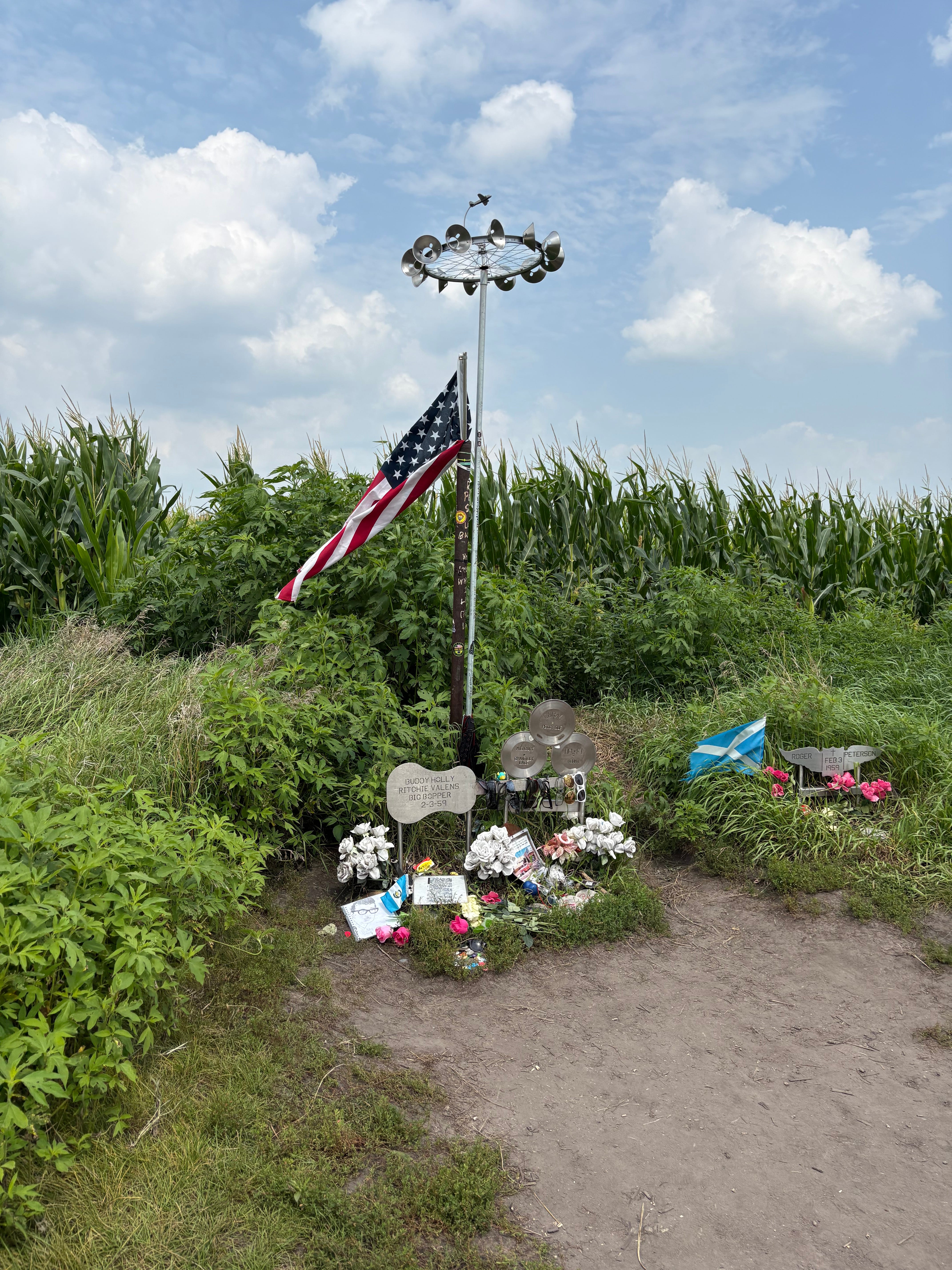
We stop, briefly, in a cornfield near Clear Lake, where Buddy Holly, Richie Valens, the Big Bopper, and a 21 year old pilot crashed on February 3, 1959. Someone maintains a parking area, good signage, and a clear path through the corn to the site itself. One fellow pilgrim notes it’s a long walk in, and the Boston in me would have commented that they might have died closer to the road if they knew it would be such an attraction. But I don’t.
The Declaration of Independence includes this passage: “All experience has shown, that mankind are more disposed to suffer, while evils are sufferable, than to right themselves by abolishing the forms to which they are accustomed.”
Back home, friends wonder if voters in red states, or Trump voters in blue states, regret their vote, six months into the administration. MAGA would say those wondering are suffering from Trump derangement syndrome. But I think the words in the Declaration are as true today as they were 250 years ago. People I talk to are living their lives, and if, as was the case with tariffs and cuts in research funding, Trump policies are impacting them, they are more disposed to suffer, while evils are sufferable.
We end our trip at the Mall of America in Bloomington, Minnesota. If we’re taking the pulse of the nation, the beat is steady from the Lego store to the Nickelodeon roller-coaster here at the biggest mall in the western hemisphere. If space aliens landed here and reported back home of their observations of this country, the Mall of America isn’t a bad presentation; diverse, in better shape than I might have guessed, and happy to be here. Outside my hotel entrance to the mall is Arwa Fashion, a shop of Islamic apparel, catering to a large local population.
The diversity of America is on display here, and part of its very foundation, if you will. If a lot of visitors are Muslim, it was built and is owned by the Ghermezian family, Orthodox Jews, who emigrated from Iran. In 1943 Jacob Ghermezian hosted U.S. President Franklin Roosevelt, U.K. Prime Minister Winston Churchill, and Soviet leader Joseph Stalin during the Tehran Conference. He emigrated with his family in the early 1950’s……to Canada.
“How the Democrats Lost Steve: Making Sense of the 2024 Election”